
Marbled Murrelets Now Threatened in Santa Cruz Mountains State and County Parks
October 9, 2026
To:
Santa Cruz District of California State Parks
Chris Spohrer, District SuperintendentSan Mateo County Resource Conservation District
Kellyx Nelson, Executive DirectorSan Mateo County Parks Department
Emma Gonzalez, Interim Parks Director
Re: Forest management operations underway in the Santa Cruz Mountains - California State Parks Forest Management Strategy and Appendices, San Mateo County Forest Health and Fire Resilience Public Works Plan and associated documents
The Pacific Seabird Group (PSG) recommends a modification of the forest fuel management program currently underway in the Santa Cruz Mountains (Marbled Murrelet Conservation Zone 6) that are associated with the implementation of the State Parks Department’s Forest Management Strategy, the San Mateo County Resource Conservation District’s Butano State Park Forest Health Project, and related plans. Some of the forest fuel reduction activities proposed and underway include tree felling by chain saws, log removal, mastication of vegetation, and the use of bulldozers and excavators. These activities are likely to have adverse impacts on Marbled Murrelets (Brachyramphus marmoratus) and their nesting habitat. These projects occur within sites occupied by nesting Marbled Murrelets, a federally-threatened and state-listed rare species, and, based on our scientific expertise, we believe that the murrelet harm avoidance measures in these plans fall short of their intended goals.
The Pacific Seabird Group (PSG) is a society of professional seabird researchers and managers dedicated to the study and conservation of seabirds. PSG was incorporated as a 501c3 non-profit in the state of California in 1972 and has an international membership from countries throughout the Pacific Basin and beyond. The principal goals of PSG are to: 1) increase the quality and quantity of seabird research by facilitating the exchange of information, 2) identify and assess the importance of threats to seabird populations, and 3) provide government agencies and others with expert advice on managing threats and populations. Over the last several decades, PSG members have provided Marbled Murrelet population status information, standardized monitoring protocols for at-sea and forest-based monitoring and assessed management alternatives for state and federal agencies and other constituents.
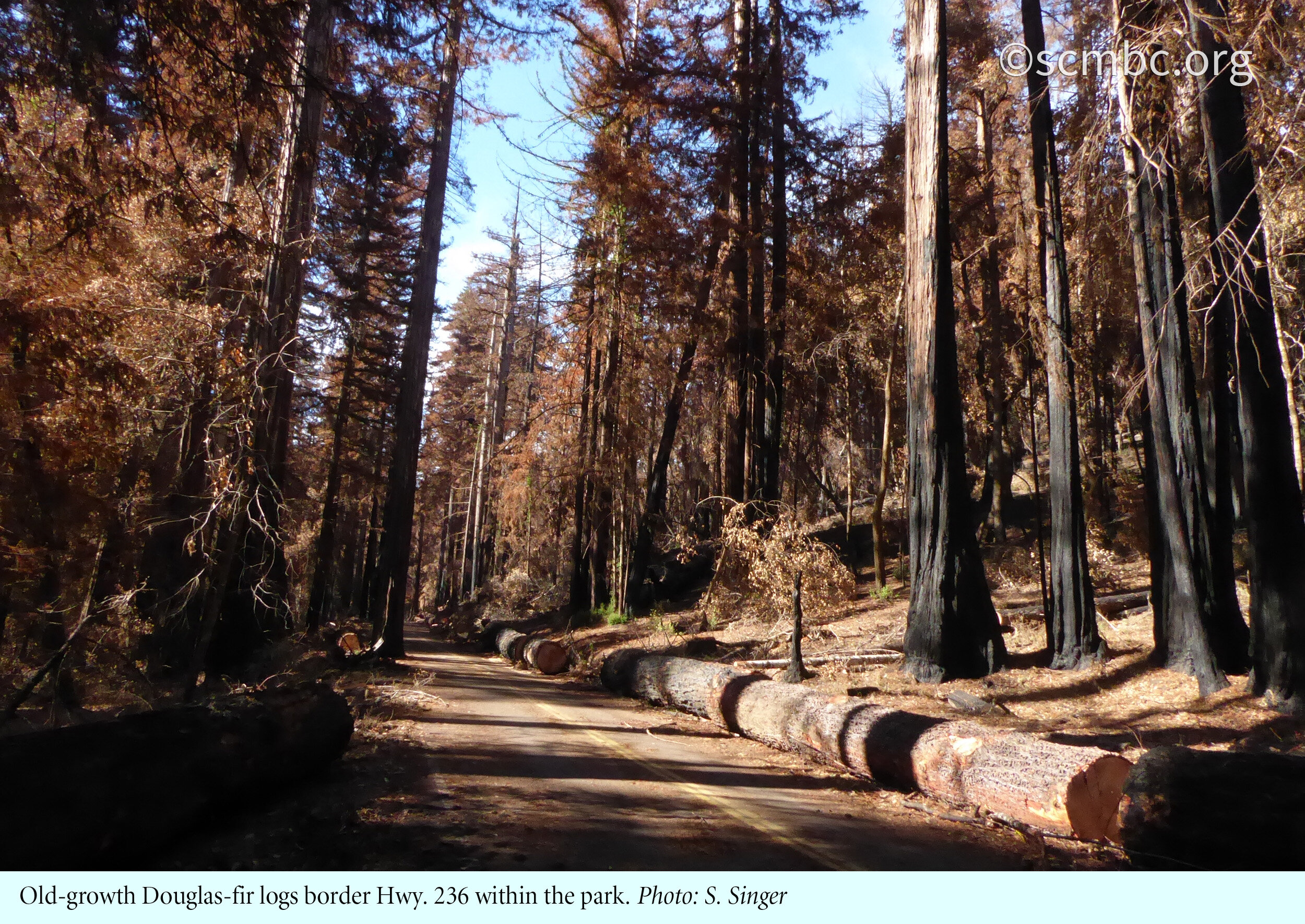
The forest management activities that concern us are those occurring within old-growth and bordering younger redwood stands in Butano State Park, Portola State Park, and surrounding areas. Long-term monitoring data confirms that these stands are occupied nesting sites. While we recognize that these fuel management plans aim to prevent catastrophic crown fires like the 2020 CZU fire — which destroyed an estimated 78% of murrelet nesting habitat in Big Basin State Park (Singer and Rinkert 2025) — it is vital to protect the remaining unburned or lightly burned stands. Fortunately, some suitable habitat remains in old-growth redwood stands outside Big Basin that were either unburned or lightly burned, including in Butano State Park, Portola State Park, and surrounding areas.
Our concern is with disturbances to nesting murrelets and their habitat (old-growth and occupied forest stands). Since only a minority of the total project work area is within old-growth stands, or occupied sites, we are only requesting a modification of the forest management actions in these areas. Specifically, we recommend:
That no forest management work occurs within occupied stands and that an adequate buffer be established around those areas to protect them from noise or other impacts originating outside of the old-growth stand.
Where there are occupied stands containing campgrounds, picnic areas, or other areas of significant human use, we support ground-based prescribed burning if it is done outside of the breeding season.
We do not recommend any tree thinning in old-growth stands as this can remove the cover vegetation required to shield murrelet nests from predators.
Additionally, we identified several flaws in the supporting evidence presented in the Forest Management Strategy. As detailed in Table 1, the project's acoustic assessment used a methodology that significantly underestimates mechanical noise levels. Furthermore, the protocol inappropriately shortens the recognized breeding season based on the incorrect assumption that Audio-Visual (A/V) and Autonomous Recording Unit (ARU) acoustic data can precisely predict the onset or cessation of nesting activity. Table 1 outlines all our concerns and recommended solutions to the proposed forest management activities within the plans.
We wish to make it clear that we are not objecting to the total project. In this specific case, in the Santa Cruz Mountains, we can see the benefit of treating younger redwood stands that have previously been harvested. We also realize that much expense and effort have gone into planning and implementing this project. Consequently, we are limiting our objections to the bare minimum needed to protect the Marbled Murrelet. For example, we have no concerns about fuel reduction efforts going forward in Año Nuevo State Reserve or Big Basin State Park where very little suitable nesting habitat remains.
We appreciate State Parks’ historical dedication to conserving murrelet habitat and funding population monitoring in Zone 6. Modifying the current fuel management project is the most effective way to build upon these successful conservation efforts and ensure the long-term survival of the Zone 6 population.
We hope to hear back from you to discuss these areas of possible improvement in the Forest Management Strategy, and to collaborate on an amicable solution that balances wildfire resistance and resilience with the best available science for Marbled Murrelet conservation. Members of PSG’s Marbled Murrelet Technical Committee are readily available to provide additional scientific information and further discuss the suggested adjustments.
Sincerely,
Scott Pearson, PhD
Vice-chair for Conservation
Pacific Seabird Group
cc:
U.S. Fish and Wildlife Service Ventura Field Office
U.S. Fish and Wildlife Service Sacramento Field Office
California Department of Fish and Wildlife – regional office
California Coastal Commission – central coast district
Literature Cited:
Singer, S.W. and A. Rinkert. 2025. Impact of the 2020 CZU Fire on Marbled Murrelet nesting habitat in Big Basin State Park. Report prepared for the Santa Cruz District of California State Parks. Steven Singer Environmental & Ecological Services, Santa Cruz, CA. Available online at www.scmbc.org.
Table 1. Recommended protective practices for murrelets and deficiencies of currently used murrelet protection measures in
Zone 6
Accepted Marbled Murrelet Protective Measure for Various Disturbances
No forest fuel reduction activities (thinning, prescribed burning, removal of downed logs) to occur within occupied stands except for within areas of high recreational use and the removal of hazardous trees
Establish no-cut, no-entry buffer zones around occupied sites during the March 24 – September 15 nesting season
No entry into occupied stands during the breeding season
Avoid loud noises during the March 24 – September 15 breeding season
Deficiencies in Current State Parks or San Mateo County RCD Practice
Fuel reduction activities conducted within occupied sites except during the period of March 24 – August 5 or September 1st, depending on location.
Existing activities will continue to some degree for next 8 years, then activities such as prescribed burning and thinning will require repeated disturbances every 7 – 10 years
Uses a buffer zone that is 30 m (100 ft) wide
Depending on location, work will occur from March 24 to August 4, March 24 to September 1, April 1 to September 1, or April 1 to September 15. These dates reduce the length of the accepted 176-day breeding season to 134, 162, 154, or 168 days, respectively
Murrelets will not be protected from disturbance during their full breeding season. Work will occur while early or late season nesting birds are on their nests
Breeding season was arbitrarily shortened by using AV and ARU survey results. Such data use is incorrect
Allows noise levels that are 30-35 dB above ambient (12) in direct disregard of USFWS guidelines (9)
Relies on a noise assessment conducted by a chief proponent of the project
Findings of the Auten Resources assessment (13) are based on an improper methodology using an incorrect sound meter setting that does not record peak sound levels. They used a record speed of “slow” when should have used “fast” or “max” (15)
PSG, USFWS, or Latest Science Recommended Practice and Supporting Facts or References
PSG: No forest alteration activities in occupied stands year-round (1). Alternative methods to reduce wildfire risk include reducing human ignitions during red flag fire weather by: temporarily closing parks and recreation sites, improving suppression capabilities while fires are still small, and modifying power lines to instantaneously shut down when the line is broken (1)
Fuel reduction actions can adversely affect the quality of murrelet habitat (2)(3)
Human activity can attract jays and ravens to the site when birds are nesting, even if work is done outside the nesting season (4)
A study found that the high severity of the 2020 CZU fire was not due to the build-up of ground fuels (5)
Old-growth plots previously subjected to prescribed burning had only a minor reduction of fire severity compared to untreated areas in the 2020 CZU fire. In both cases suitable murrelet nest trees were lost (6) (7)
PSG: Buffer zone to be 100m (328 ft) wide -- to avoid disturbance of nesting murrelets or disruption of feeding visits which can occur at any time of the day (1)(8)(9)(10)
Murrelets use below-canopy flight corridors to approach the nest (2)
Visual or noise disturbances occurring up to 100m out from the nest could cause the loss of feeding visits and lead to chick mortality (9) (10)
PSG: No entry period is to extend from March 24 – September 15 (2)
AV and ARU survey data are not designed for determining start dates and end dates of the breeding season. Late season murrelets are most likely attending a nest and would not be calling or circling, so would not be detected by these types of surveys (2)
After a first failed nesting attempt, murrelets can re-nest and try again (11)
10% of known or projected murrelet fledge dates in Zone 6 occurred on or after September 2nd (12)
PSG recommends following USFWS recommendation that noise at the nest site not exceed 20-25 dB over ambient (1)(9)
Chain saws, tree felling, mastication, yarding, and heavy equipment operations create loud noises.
If correct sound meter settings were used, much of their equipment would likely have exceeded 25 dB over ambient.
Noise assessments should be done by an unbiased third-party consultant with professional experience in sound measurement.
Supporting References:
(1) Pacific Seabird Group. 2024. Terrestrial Habitat Management Recommendations for Marbled Murrelets. Pacific Seabird Group Tech. Pub. Number 7. 38 p. Available at https://pacificseabirdgroup/psg-publications/technical-publications.
(2) Pacific Seabird Group. 2024. A Revised Protocol for Surveying Marbled Murrelets in Forests. Pacific Seabird Group Tech. Pub. Number 6. Available at https://pacificseabirdgroup/psg-publications/technical-publications.
(3) Singer, S.W. 2026. Mass Irruption of Ceanothus After the 2020 CZU Fire Provides a Lesson for Redwood Forest Management. Santa Cruz Mountains Bioregional Council. Available online at www.scmbc.org .
(4) Seckel, L.E. 2011. Corvid Distribution, Human Recreation, and Park Management in Mt. Rainier National Park. M.S. Thesis, University of Washington
(5) Safford, H.D., A.K. Paulson, Z.L. Steel, D.J.N. Young, and R.B. Wayman. The 2020 California Season: A Year Like No Other, A Return to the Past, or a Harbinger of the Future? Global Ecol. Biogeogr. 30 (10).
(6) Biblin, S., W. Russell and K. Wilkin, 2025. Long -term Influence of Prescribed Burning on Subsequent Wildfire in an Old-growth Coast Redwood Forest, Fire Ecology 21:11.
(7) Singer, 2026 unpublished data from 107 suitable nest trees monitored before and after the 2020 CZU fire in Big Basin State Park.
(8) U.S. Fish and Wildlife Service (USFWS) 1997. Recovery Plan for the Marbled Murrelet (Brachyramphus marmoratus) in Washington, Oregon, and California. Oregon Field Office, Portland, OR.
(9) USFWS 2020. Revised Transmittal of Guidance: Estimating the Effects of Auditory and Visual Disturbance to Northern Spotted Owls and Marbled Murrelets in Northwestern California. Memorandum from USFWS Arcata office.
(10) Nelson, S.L. and K. Fitzgerald. 2024. Potential Nutritional effects of Missed Feedings to Marbled Murrelet (Brachyramphus marmoratus) Chicks Due to Disturbance. Northwest Science 97(1-2):2-14.
(11) Hebert, P.N, H.R. Carter, R.T. Golightly, and D.L. Orthmeyer. 2003. Radio-Telemetry Evidence of Re-nesting in the Same Season by the Marbled Murrelet. Waterbirds 26(3):261-265.
(12) Halbert, P. and S.W. Singer 2017. Marbled Murrelet Landscape Management Plan for Zone 6. Santa Cruz District of California Department of Parks and Recreation. Available at www.parks.ca.gov/MAMU .
(13) Halbert, P. 2024. Avoidance Measure Recommendations for Marbled Murrelets in the Santa Cruz Mountains Following the CZU Lightning Complex – Appendix G, in, Santa Cruz District of California State Parks, Big Basin Redwoods State Park, Butano Redwoods State Park, or Ano Nuevo State Reserve – Forest Management Strategy.
(14) Auten Resources Consulting. 2022. General Sound Assessment and Action-Generated Noise Analysis Within Hubbard County Park, Pescadero Creek County Park, and Big Basin Redwoods State Park.
(15) Mastech Group. n.d. Mastech Model 6708 Digital Sound Level Meter Operation Manual (same as VLIKE LCD Model VL6708). Available online at www.mastech-group.com/global/en/ms6708.html.